


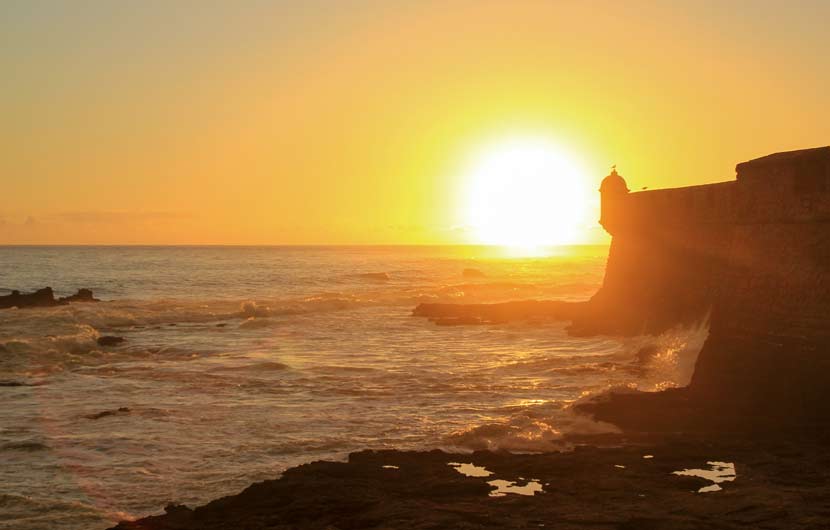
Spain lies in the temperate zone, and its climate is determined by its world position, continental land mass, and mountainous terrain. This produces one of the most diverse and varied climates in Europe.
The Cantabrian mountains in the central northern region mark the first well-defined division of Spain's climate.
To the north of this range lies what we may call rainy Spain, which includes the Basque Country, Cantabria, Asturias, and Galicia.
This region has a maritime climate par excellence, with only slight variations in temperature, mild winters and cool summers, lots of clouds and frequent rainfall during the winter months.
This climate in Spain is typical of western Europe, favouring a northern European type of vegetation.
In terms of surface area, rainy Spain accounts for about a third of the country, while the other two-thirds comprise the dryer, warmer part of Spain.
Spain’s Climatic Zones
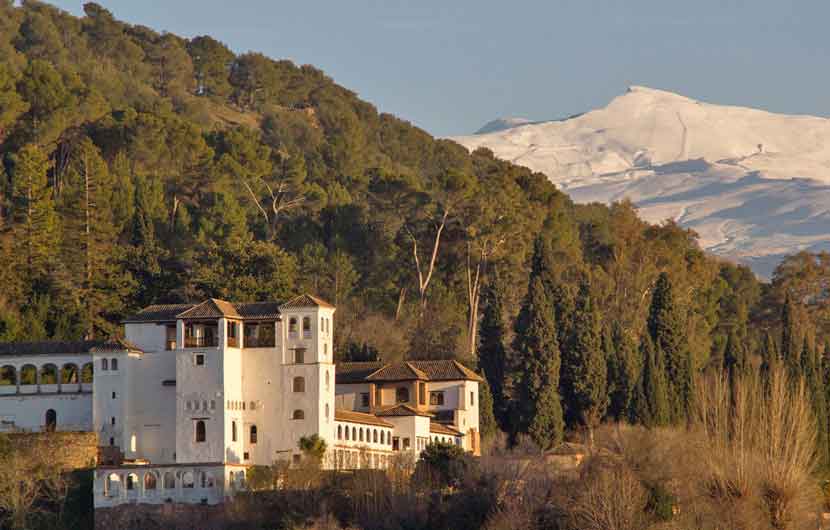
Spain’s climatic zones range from the snow-peaked Pyrenees and the Sierra Nevada to the sun-baked semi-desert of the high central plain and Almeria.
In Northern Spain, there is a great deal of climatic variation (both regionally and seasonally).
Green Spain stretches from the Basque country along the Atlantic seaboard through Cantabria and Asturias to Galicia. It is named because it rains a lot (so take waterproofs, umbrellas and suitable footwear – even in summer).
Bilbao and Santiago are also renowned for being very rainy, and the pasture-clad hills are often swathed in mist.
Winters in the north and northwest can be very wet, and it may even snow. On the contrary, Summers have lavish measures of sunshine and warmth everywhere, increasing in intensity as you travel inland and cross the mountains of the Cordillera Cantabrica.
The north is, therefore, an ideal destination for a family beach holiday. Hundreds of beautiful coves and beaches (many sheltered and backed by green fields) and seaside resorts have long been popular among Spaniards in the hot season.
Central Spain's climate is continental, with baking hot summers and relatively cold winters. The southern Meseta is also exceedingly dry; Madrid has a relatively temperate climate.
In autumn and spring, both delightful seasons, average temperatures range from 12-15°C (54-60°F), with a spread of 6°C (43°F) minimum, to 21°C (70°F) maximum. Summer and winter are more extreme.
In summer, temperatures can reach 40°C (104°F), although mountain breezes can make the evenings slightly cooler. The average winter temperature is 5°C (41°F), although it can drop below 0°C (32°F) in January, the most unsettled month of the year.

You’ll need to bring your winter coat. Although it does not rain often (with an annual rainfall of about 438mm per year), the wettest months are January and April. In Eastern Spain, Catalonia has a climate as varied as its geography.
In Andorra and the Pyrenees, the temperature can drop below freezing in winter (and almost certainly will do!).
North of the Costa Brava, winds generate out of nowhere and last for several days. But a bit further south, the climate is more reliable, with little rain in summer. The average temperature in coastal resorts is 25°C (77°F) in summer and 11°C (52°F) in winter.

Inland can be much hotter, and visitors may prefer spring and autumn. In Southern Spain, Andalusia’s position at the southern edge of Europe gives it a privileged climate.
Summers are hot, and winters are generally mild. However, there are considerable variations due to the size of the region, its mountainous character, and its bordering on the Atlantic and Mediterranean.
In areas of Spain, summers can be extremely hot in the interior, with temperatures rising to 45°C (113°F) and even higher in the provinces of Seville and Cordoba.
Almeria has a highly arid, desert-like climate. Snow covers the Sierra Nevada from November to June; frost is common in upland areas.
The Levante wind has considerable influence. It often blows hard for days on the Cadiz coast and creates a persistent cloud over the Rock of Gibraltar.
June to October are usually dry months, except for sporadic torrential downpours. Heavy rain in the winter months is generally interspersed with brilliant sunshine.

The Canary Islands experience a subtropical climate and mild temperatures all year round (an average of 24ºC). Winter/summer temperatures range on average from 17-23°C (64-74°F) in Tenerife or 16-22°C (62-72°F) in Gran Canaria.
The more mountainous zones of Tenerife and Gran Canaria receive abundant rain in winter, which is responsible for the beautiful landscape, in direct contrast to the other drier and more desert-like islands.
The Balearic Islands have more or less the same weather conditions, with local variations caused by phenomena such as Mallorca’s high mountain ranges. The Balearics’ average high temperature is 21.2°C (70°F), average low 13.8°C (57°F), and the sun shines annually to an average of 59 per cent. Rainfall in Mahon, Menorca, is 580mm (23 inches) a year, while that in Palma, Mallorca, only reaches 480mm (19 inches).
Continental Climate
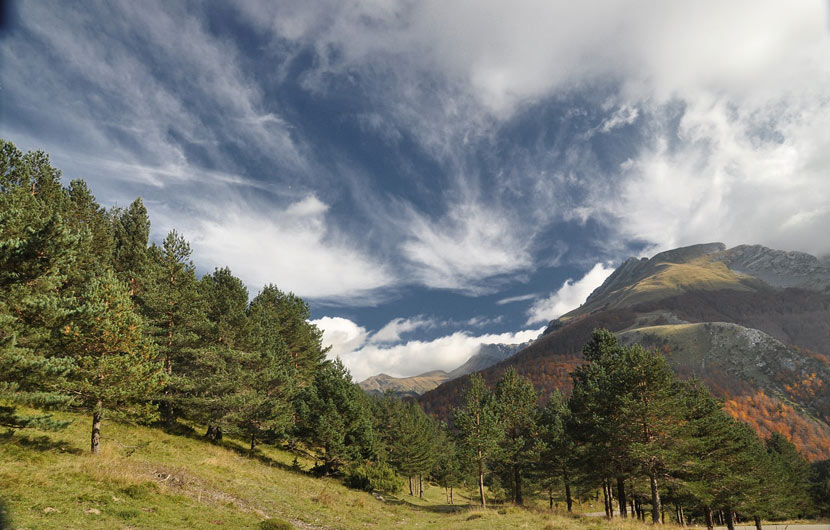
A continental climate is characterised by wide seasonal variations in temperature and low, irregular rainfall with high rates of evaporation that leave the land arid. Annual rainfall generally is thirty to sixty-four centimetres; most central plains receive about fifty centimetres.
The northern Meseta, the central system and the Ebro Basin have two rainy seasons, one in spring (April-June) and the other in autumn (October-November), with late spring being the wettest time.
In southern Meseta, the wet seasons are spring and autumn, but the spring one is earlier (March), and autumn is the wetter season. Even during the wet seasons, rain is irregular and unreliable.
Continental winters are cold, with strong winds and high humidity despite the low rainfall.
Except for mountain areas, the northern foothills of the Sistema Iberico are the coldest, and frost is common.
Summers are warm and cloudless, with average daytime temperatures reaching 21° C in the northern Meseta and 24 to 27° C in the southern Meseta; nighttime temperatures range from 7 to 10 C.
At a lower altitude, the Ebro Basin is extremely hot during the summer, and temperatures can exceed 43 C.
Summer humidity is low in the Meseta Central and in the Ebro Basin, except right along the shores of the Rio Ebro, where humidity is high.
Maritime Climate

A maritime climate prevails in the northern part of the country, from the Pyrenees to the northwest region, characterised by relatively mild winters and warm but not hot summers. Generally, abundant rainfall is spread out over the year.
Temperatures vary only slightly, both on a diurnal and a seasonal basis. However, the moderating effects of the sea abate in the inland areas, where temperatures are 9 to 18 C more extreme than temperatures on the coast.
Distance from the Atlantic Ocean also affects precipitation, and there is less rainfall in the east than in the west. Autumn (October through December) is the wettest season, while July is the driest month.
The high humidity and prevailing off-shore winds make fog and mist common along the northwest coast; however, this phenomenon is less frequent a short distance inland because the mountains form a barrier keeping out the sea moisture.
Mediterranean Climate

The Mediterranean climatic region extends from the Andalusian Plain along the southern and eastern coasts up to the Pyrenees, on the seaward side of the mountain ranges that parallel the coast.
Total rainfall in this region is lower than in the rest of Spain, and it is concentrated in the late autumn-winter period. Generally, rainfall is slight, often insufficient, irregular, and unreliable.
Temperatures in the Mediterranean region are usually higher in both summer and winter, and diurnal temperature changes are more limited than those of the continental region.
Temperatures in January typically average 10ºC to 13ºC in most Mediterranean regions, and they are 9ºC colder in the northeastern coastal area near Barcelona. In winter, temperatures inland on the Andalusian Plains are slightly lower than on the coasts.
Temperatures in July and August average 22ºC to 27ºC on the coast and 29ºC to 31ºC farther inland, with low humidity.
The Mediterranean region is marked by Leveche winds which are hot and dry, these are easterly or southeasterly air currents that originate over North Africa. These winds, which sometimes carry fine dust, are most common in spring.
A cooler easterly wind, the Levante funnels between the Penibetico system and the Atlas Mountains of North Africa.
Subtropical Climate
To find a subtropical climate in Spain, you must head off to the Canary Islands, which has an average temperature well above 14ºC with summer temperatures around 25ºC.