


Santiago de Compostela Cathedral

Info, Tours & Tickets

The Cathedral of Santiago de Compostela is one of Spain’s most visited tourist sites, and once you have visited this extraordinary historic site you will understand why.

The beauty of its architecture is undeniable as it sits divinely within the region of Galicia in northwestern Spain. It is clear why this architectural marvel continues to draw thousands and thousands of visitors worldwide.

Santiago de Compostela
Santiago de Compostela Cathedral

Besides being one of Spain’s most important religious structures, it is also surrounded by several remarkable and historic buildings like the Gelmirez Palace, Rajoy Palace, Catholic Kings Hostal, and San Jeronimo College.

The History of the Cathedral

Santiago de Compostela Cathedral

Construction of the great Santiago de Compostela Cathedral began in the 11th century when Alfonso VI was King of Spain. It was constructed under the supervision of Bishop Diego Peláez.

The Cathedral was constructed on the grounds of a former church dedicated to the great St James, or Saint Santiago, as the Spaniards call him.

At the beginning of the 12th century, the great architect Esteban constructed three naves that form a large Latin cross.

The Cathedral is also one of the only three remaining churches built over the burial chamber of an apostle of Jesus. The other two are St. Thomas Cathedral Basilica in Chennai, India, and St. Peter’s Basilica in Vatican City.

It was declared a World Heritage site by UNESCO in 1985.


Interesting Facts About  Santiago de Compostela Cathedral

  1.  The cathedral is said to house the remains of St James.
  2.  St.James was beheaded in the wars of the holy lands
  3. The Cathedral allows pilgrims to walk around the interior along extended isles.
  4. The Baroque Altar glitters with real gold.
  5. The sarcophagus of Saint James was discovered in the early 9th century.
  6. The original church was consecrated in 1211 in the presence of King Alfonso IX.
  7. The giant incense thurible dates back to the mid 19th century.

Mass & Confessions

Santiago De Compostela Cathedral

Confessions are available during the morning and afternoon at the Cathedral.

If priests are unavailable in the confession booth or need to confess in your language, you can request it at the vestry room.

Currently, the Church is undergoing massive renovations, and as such, pilgrims have to attend the mass that takes place in other churches around the town.

The Thurible

Santiago De Compostela Cathedral

As it is called in the Galician language, censer, or the thurible, is an iconic symbol of the Santiago de Compostela’s Cathedral.

This large censer is hung using a pulleys system from the central cupola of the Cathedral, and it swings majestically through the central nave.

The censer weighs about 53 Kilograms and takes almost a dozen men to move it. It is 1.5 meters in height which makes it one of the world’s largest thuribles.

It measures almost 20 meters in length when it dangles from the central cupola.

The Great Cathedral Doors
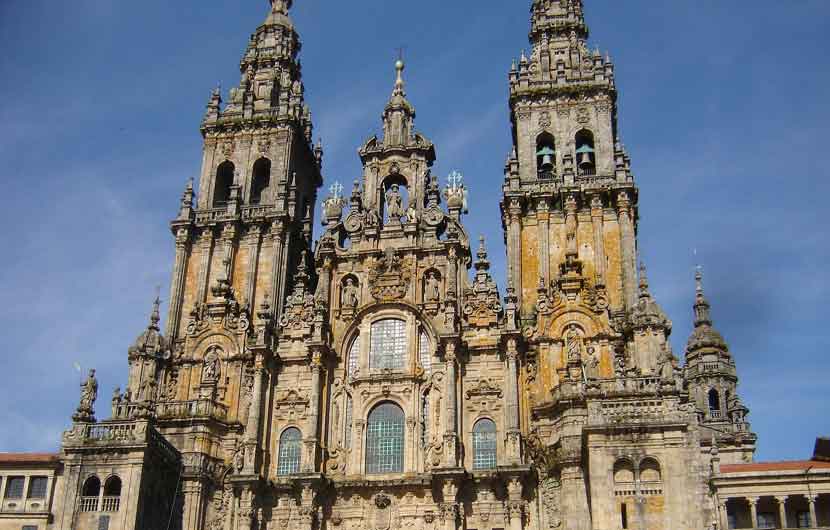
Santiago Compostela Cathedral

The Porta Sancta, or the Holy Door, was constructed in the 1700s. it is also known as the Door of Forgiveness.

You can find the Porta Sancta in the Praza Da Quintana, going through the door leads to the Saint James crypt and the Cathedral’s Main Altar.

There is also a picture of St James for pilgrims to hug as part of the pilgrimage tradition.

Designed in the 1300s by the skilled Mestre Mateo, the Pórtico of Glory is a Roman-style splendid structure that shows off more than 200 granite bible personalities throughout three grand archways inside the western side of the glorious Cathedral.

The archway depicts the great Saint James is at the central, ushering in new pilgrims or visitors to the magnificent Cathedral.

There are different themes depicted in the archways. These themes include the end of days, the Day of Judgment, the noble prophets, and the saints.

St James Tomb

Santiago De Compostela

Many believe that the Cathedral site is the final resting place of the Great Saint James, a disciple of Jesus Christ.

The remains of Saint James and two of his disciples, Saint Athanasius and Saint Theodore, are preserved in a silver jar in the catacomb beneath the Main Altar.

These artifacts of St. James have transformed Santiago De Compostela’s independent old town into a crucial destination for pilgrims globally.

Visiting The Cathedral

Praza do Obradoiro, s/n, 15704 Santiago de Compostela, A Coruña

» Reserve tours and entrance tickets.

Getting There

Get Directions

Enter your starting address:


By Car:

There are excellent roads and motorways. The A-6 and A-52 motorways connect Galicia to the rest of Spain and link to Santiago via the AP-9.

Car Parking:

Saba Parking:  https://www.saba.es/en/
Parclick:  https://parclick.com/parking-santiado_de_compostela
Rosalia Parking: https://elparking.com/en/a-coruna/parking-rosalia/13247

By Bus:

Santiago de Compostela Bus Station is located in north-central of the city.

Coach services leave every hour to and from other towns in Galicia including Vigo, Pontevedra and A Coruña.

The Number 5 bus has the closest stop to the cathedral.

By Train:

There are good communications with the rest of Spain when it comes to rail travel.

Trains run from Santiago de Compostela Railway Station to and from all the major cities such as Madrid, San Sebastián and Barcelona.

Take the Number 6 bus from the station.

» National Train Provider:  Check timetables and book online via the Renfe the national train service provider.

» Interurban Trains: www.renfe.com/es/en/

Plane:

Santiago Airport is located just 10 kilometres outside the city.

By Bike:

There are a number of good bike hire companies in the city:

Tornride: https://www.tournride.com/


Opening Times

Basilica (Sepulchre of Saint James the Apostle)

Every day, from  10 am to 8 pm.

Museum (Permanent Collections, Gelmírez Palace & Portico of Glory)

Every day, from  10 am to 8 pm.

Cathedral Archives & Library

Every day, from  10 am to 8 pm.

Pilgrim’s Reception Office

From Monday to Saturday, from 12 noon to 4 pm (April 1st - 11th, from 12 noon to 6 pm).

Audio guides are available in four languages:  Spanish/French/English/Gallego

» Reserve tours and entrance tickets.

Cathedral and Museum Guided Tour

Santiago Compostela Tours


Recommended Hotels Nearby

Located near the iconic cathedral, these places to stay promise not just a stay but an immersive experience of the city's rich history.

The Parador de Santiago de Compostela is an architectural gem, housed in the former Royal Hospital. Offering luxury and history in one, it provides unparalleled views of the cathedral.

For those seeking elegance, Hotel Palacio del Carmen, Autograph Collection, offers a refined stay. Set in a converted convent, this boutique hotel seamlessly blends historic charm with modern comforts to create a tranquil retreat.

The NH Collection Santiago de Compostela, located a short walk from the cathedral, provides contemporary sophistication. Its sleek design, attentive service, and proximity to the city's main attractions make it an excellent choice for discerning travellers.

For budget-conscious travellers, Hotel Entrecercas offers a charming stay in a traditional Galician house. With a homey ambience and a central location, it offers affordability without compromising the authentic Santiago experience.