

Embark on a journey through the hidden gems of Madrid, uncovering cultural riches often overlooked by the hurried traveller.
Beyond the bustling streets and iconic landmarks lies a tapestry of amazing cultural sites to visit in Madrid, waiting to be explored
Madrid's Civil War bunkers, remnants of a tumultuous past, whisper tales of resilience amid conflict. As you traverse the labyrinthine lanes, encounter the grandeur of Gran Vía – a boulevard adorned with architectural wonders and a testament to the city's evolution.
Step back at the Arab city walls, standing stoically as echoes of medieval life resonate through their stones.
The Temple of Debod, a gift from Egypt to Spain, adds an unexpected touch of ancient allure amidst the urban sprawl.
Delve into the subterranean world at Chamberi Metro Station, frozen in time, offering a unique glimpse into the city's transportation history.
Join us as we peel back the layers and unveil the lesser-known cultural sites that make Madrid a treasure trove for the discerning adventurer.
Here, then, are lovely cultural gems you shouldn’t miss when visiting Madrid.
1. Arab City Walls

Standing as silent sentinels to Madrid's storied past, the Arab City Walls on Calle Mayor is a testament to the city's rich and diverse history.
Originally built during the 9th century when the Moors held sway over the Iberian Peninsula, these walls encapsulate Madrid's medieval origins.
Their strategic construction was a protective barrier, offering refuge to the burgeoning settlement.
These ancient Arab walls can be found at the end of Calle Mayor, a stone's throw from the impressive Almudena Cathedral and the Royal Palace.
The brickwork, adorned with time's patina, whispers tales of battles, conquests, and the ebb and flow of civilisations.
As you trace the contours of the walls, you can almost feel the pulse of medieval life.
Despite the modernity surrounding them, the Arab City Walls retain an air of mystery and enchantment.
A stroll along Calle Mayor is a journey through time, with the Arab City Walls providing a tangible link to the city's captivating history.
( Google Maps )
Nearest Metro Station: Estacion.
2. Gran Via

Madrid’s answer to the Champs-Elysees, Gran Vía, is the ornate, elegant main artery connecting the city centre with the districts to the north.
Completed in the 1920s when Madrid underwent significant expansion and beautification, the boulevard features remarkable architecture fusing styles such as French Beaux-Arts, Art Nouveau and early Spanish Modernism.
Wander the length of Gran Via to take in sights like the iconic Metropolis building and admire the sheer grandeur of its tower-topped memorials, banks and hotels from Madrid’s Belle Epoque era.
This iconic district encapsulates the essence of Madrid's transition to a cosmopolitan metropolis.
Lined with majestic buildings, theatres, and shops, Gran Via epitomises the architectural exuberance of the early 20th century, displaying a fascinating blend of Art Deco and Art Nouveau styles.
Today, Gran Via is a bustling activity hub offering many attractions.
The street is a shopper's paradise, adorned with high-end boutiques and familiar brands.
The district's theatres, such as the iconic Gran Via Theatre, host diverse performances, from Broadway shows to Spanish plays.
Gran Via is not just a destination; it's an experience, making it a must-visit destination if you want to soak in Madrid's essence.
( Google Maps )
Nearest Metro Station: Gran Via
3. Templo de Debod

Hidden away in the Parque del Oeste lies an ancient Egyptian temple that once stood on the banks of the River Nile; it has become one of the top visited cultural sites in Madrid.
Dating from the 2nd century BC, the Templo de Debod was donated to Spain in thanks for its assistance in saving temples during the Nile Valley flooding crisis of the 1960s.
The temple was dismantled and gifted to Spain in 1968 as a gesture of gratitude for its help saving Abu Simbel from the rising waters of the Aswan High Dam. The Temple honours the goddess Isis and the god Amun.
Madrid's Parque del Oeste now cradles this architectural treasure, allowing visitors to marvel at the stunning sunset views over the cityscape from its serene surroundings, creating a unique fusion of history and modernity.
The small but perfectly preserved sandstone monument makes for an unexpected attraction to explore in Madrid.
When it’s beautifully illuminated at night, the temple is particularly worth visiting as you gaze out towards the city lights.
( Google Maps )
Nearest Metro Station: Principe Pio and Ventura Rodriguez.
4. Civil War Bunkers

Concrete bunkers and dugouts are scattered throughout Madrid’s parks and squares, and they remain from the Spanish Civil War siege of 1936-39.
Built by citizens defending the city from military bombardment and air raids, many bunkers now lie abandoned, covered in graffiti and vegetation.
Madrid's Civil War Bunkers, known as "Refugios Antiaéreos," provide a fascinating glimpse into the city's tumultuous past during the Spanish Civil War (1936-1939).
Most bunkers and machine gun posts you can explore are located north of the city, including the Parque de la Cuna Verde in the Latina Neighbourhood, Casa de Campo and the Chamberi district.
One of the best bunkers to visit in Madrid is the Bunker de Miaja, located close to the Adolfo-Suarez Madrid Barajas Airport.
The Miaja Civil War Bunker in Madrid's Cuartel del Conde-Duque preserves a key wartime command centre.
Accessible through guided tours, it offers insight into General Miaja's strategic decisions during the Spanish Civil War.
The nearest Metro station is Noviciado, making this historical site easily reachable for visitors exploring Madrid's wartime legacy.
( Google Maps )
Nearest Metro Station: Noviciado
5. Chamberi “Ghost” Metro Station

Chamberi station offers a portal to Madrid’s metro history. Designed by architect Antonio Palacios, the early 20th-century station was closed in 1966 and left abandoned for decades.
Thanks to recent conservation efforts, including the Anden 0 project, Chamberi has been restored to its former glory - original decorative tiles, period furniture and bright colours transport visitors back through time.
Travellers can venture down to the vintage platform with audiovisual displays recounting stories of Madrid's first metro line, which opened in 1919.
Palacios opted for a straightforward, functional design in the system's beginnings. But Chamberí’s life was short-lived, as expansion works saw the sloping, curved station closed by the 1960s.
If you plan to use the metro often during your stay, we advise you to buy one of the multi-trip Public Transport Card (TTP) cards offered by Metro-Madrid. These are available for singles and families and will save you money in the long term.
You can start your journey from the Chamartin and Atocha train stations if you are a train enthusiast. These are the most extensive rail terminals in Madrid, offering departures to all the major cities in Spain.
And if you plan to visit Madrid from afar, you can also book sleeper trains via online sites such as Omio, Renfe and Trainline from countries such as Portugal or France.
( Google Maps )
Nearest Metro Station: Moncloa or Arguelles
6. Interactive Urban Exploration Game

Explore Spain's capital city of Madrid with an interactive, self-guided discovery game powered by your smartphone's web browser.
Embark on a unique exploration of Madrid's historical centre through an interactive game on your cellphone.
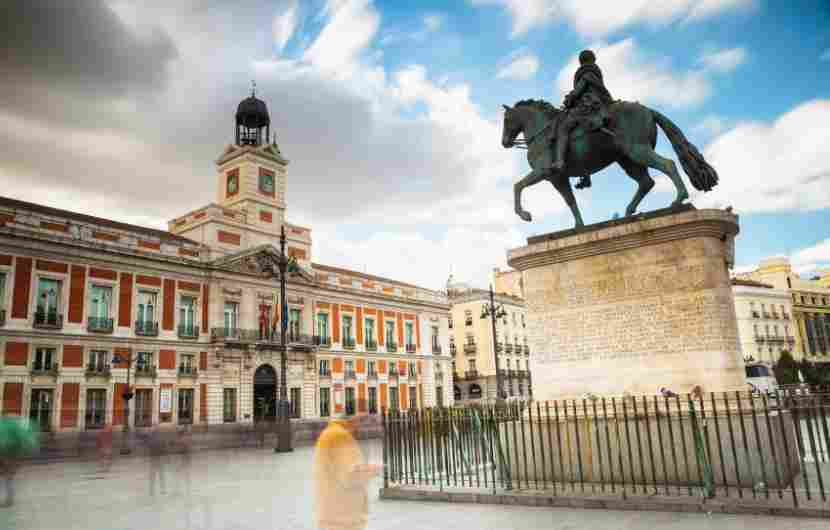
Starting at Puerta del Sol by the Cathedral, open the provided email link to initiate your adventure.
Learn intriguing details about the city, uncover secrets of major attractions, and explore exclusive information.
Navigate the city streets with cryptic clues, prompting attention to often overlooked details. Arrive at each stop, solve a question using your surroundings, and gain a fresh perspective on the city.
This discovery trail offers a unique view of the city, revealing hidden gems even for locals.
Solve 11 riddles, unlocking local insights, fun facts, and historical information about the Royal City's landmarks.
Explore El Oso y El Madrono statue and the Royal Theatre's facade, and revel in Calle Cava Baja.

7. Explore The Historic San Miguel Food Market

The Mercado de San Miguel is a vibrant culinary hub, offering a captivating blend of history and gastronomy.
Located near Plaza Mayor, this iconic market is a cultural and gastronomic treasure trove for locals and tourists.
The Mercado de San Miguel dates back to 1916 when it was initially an open-air market. In 2009, it underwent a meticulous restoration, transforming it into the covered market we see today. Its cast-iron structure, adorned with intricate detailing, adds to the architectural allure.
Opening its doors daily, you can immerse yourself in a sensory journey from 10 a.m. to midnight (closing at 10 p.m. on Sundays).
This late closing time makes it a popular spot for daytime indulgence and nighttime tapas exploration.
Inside, a tapestry of stalls offers a gastronomic feast showcasing Spanish culinary delights. From freshly shucked oysters to Iberian ham, artisan cheeses, and an array of regional wines, the market encapsulates the essence of Spanish cuisine.
It's a culinary haven where visitors can savour traditional dishes like paella, pintxos, churros and a Bocadillo de Calamar ( battered squid sandwiches ).
The market is easily accessible by public transport; the nearest Metro station is Opera. Its central location and diverse offerings make it a must-visit destination, providing a delightful immersion into Madrid's rich culinary heritage.
( Google Maps )
8. Atocha Train Station
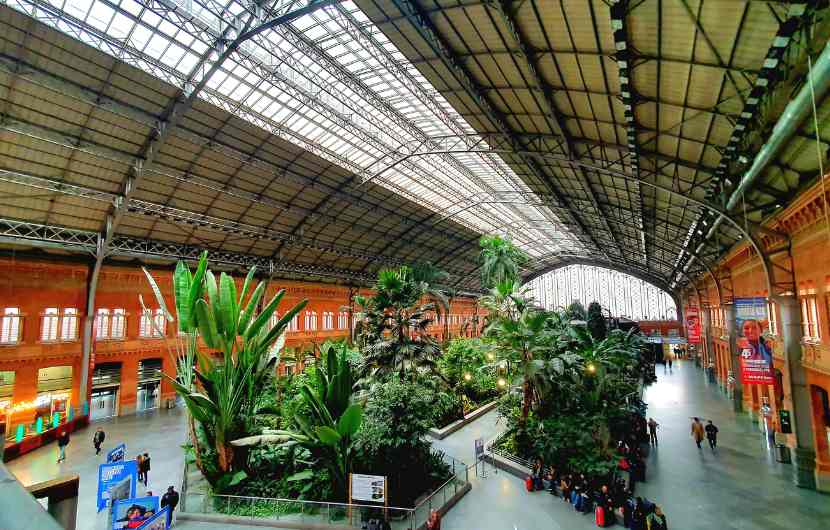
While Atocha Train Station's exterior appears typical for a European railway hub, its interior holds a remarkable surprise.
Constructed in the mid-19th century and still Madrid's largest train station, Atocha houses an extraordinary tropical garden.
Inaugurated in 1992, this lush oasis features approximately 7,000 plants, predominantly tropical varieties.
Some of these plants, reaching heights comparable to the station's interior, create a stunning contrast to the usual train station environment.
The station features a range of impressive artistic elements, including a large indoor pond with terrapins and sculptures.
Atocha also houses a poignant memorial to the victims of the Madrid train bombings. Located in the station's atrium, it consists of an eternal flame and a memorial wall. It serves as a solemn reminder of the tragic events that occurred on March 11, 2004.
This bustling transport hub with a thriving tropical haven makes Atocha Train Station a unique and unexpected destination worth visiting.
( Google Maps )
9. The Crystal Palace

The Palacio de Cristal, or the Crystal Palace, is a real jewel in Madrid's famous Retiro Park.
Erected in 1887, this iconic glass and iron structure was initially designed to house exotic flora during an exhibition in the Philippines. Today, it stands as a symbol of Madrid's cultural heritage.
Open to the public, the Palacio de Cristal invites visitors to marvel at its intricate architecture and explore the contemporary art exhibitions it hosts.
The transparent walls offer panoramic views of the surrounding Retiro Park, enhancing the immersive experience.
The Crystal Palace's operating hours vary seasonally, so it's best to check the official website before arrival.
As a general guideline, it is open to the public from 10 am until 6 pm during winter and until 8 pm in summer.
Retiro, Ibiza and Estacion del Arte are the nearest Metro stations, each providing easy access to the Crystal Palace.
Use Bus Routes 152, 20, 26, 63, C2, 61, and C1.
( Google Maps )